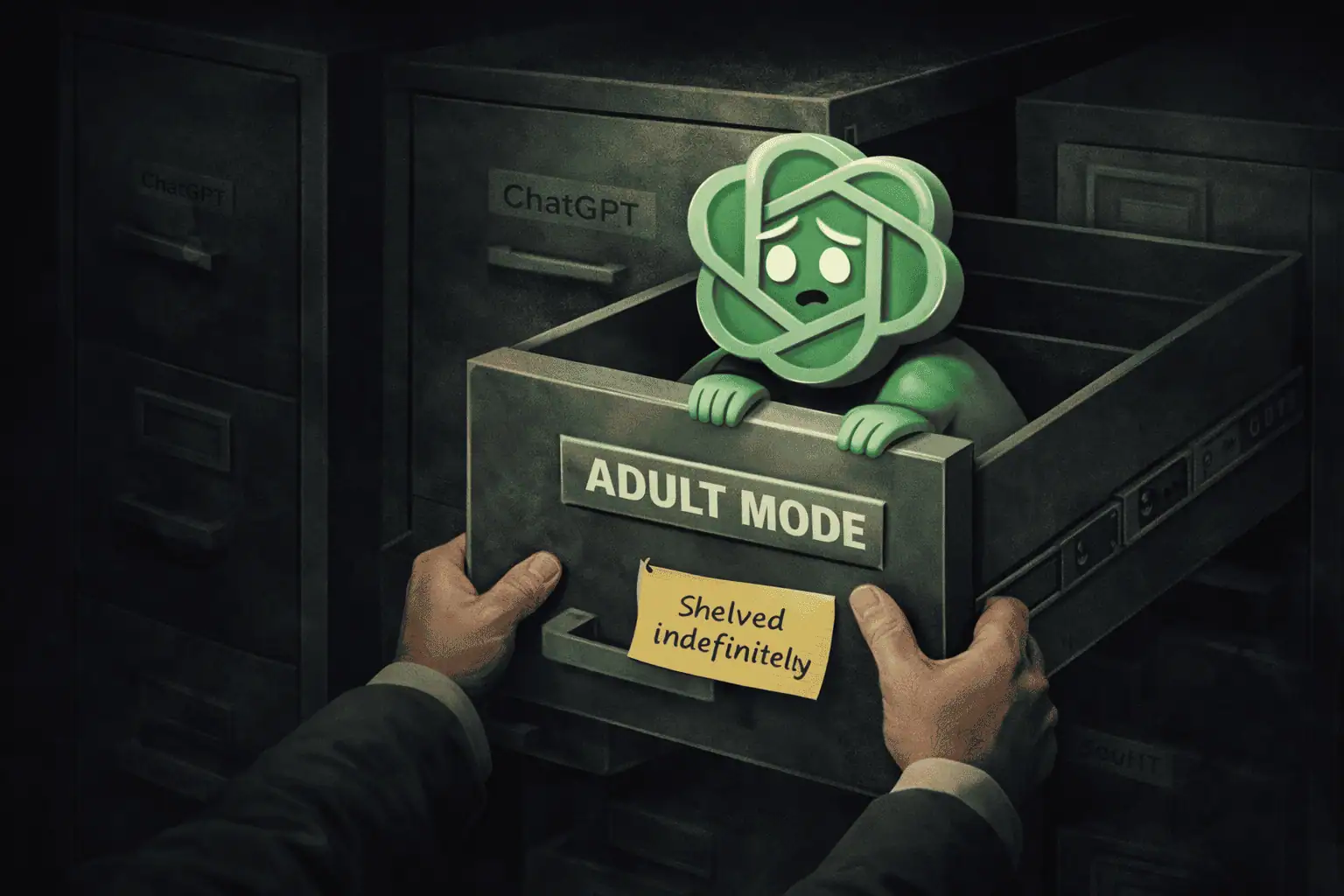
Is ChatGPT Getting An Adult Mode? What OpenAI Has Actually Said
There was a time when being an adult meant something simple. You reached a certain age, and you were expected to handle your own choices, your own risks, and your own private life. That idea is fading fast.
Now we live in a world where giant tech companies want to decide what grown adults can read, write, joke about, fantasize about, or say to a machine. And if those same adults want access to more open conversations, the deal on the table looks ugly: upload a government ID, scan your face, or let an AI system study your behavior and guess your age. OpenAI has publicly discussed mature-content access for verified adults in ChatGPT, while also rolling out age-prediction systems and verification flows. That is why this story feels bigger than one feature. It is about who gets to control adulthood in the digital world.
Yes, OpenAI talked about adult mode
This is not internet fan fiction. OpenAI really did float the idea.
The company clearly saw demand. Many users are tired of AI chatbots acting like sanitized babysitters. They do not want every adult conversation flattened into corporate-approved mush. They want tools and apps that can handle darker fiction, sexual content, blunt language, and complicated human reality without immediately slamming into moderation walls.
OpenAI did publicly say it planned to allow mature content, including erotica for verified adults. Reuters reported that CEO Sam Altman said this in October 2025 as part of a “treat adult users like adults” push. OpenAI’s adult mode was the feature in question. Adult mode would have enabled ChatGPT to engage in erotic or NSFW conversations, raising concerns about content moderation, minor access, and ethical risks.
OpenAI ultimately decided to push the launch of the adult mode, shelving the feature for now, resulting in a lost opportunity for users seeking more mature content options. Internal debates among employees and concerns about operating such a sensitive feature contributed to the company’s decision, reflecting shifting priorities and operational safety considerations.
The shelving of ChatGPT’s adult mode was reported in the same week as other major AI industry news. Public comment and reaction to OpenAI’s announcement have highlighted both support for safety measures and disappointment from users seeking more open AI conversations.

OpenAI Shelves the Idea
OpenAI’s decision to hit pause on ChatGPT’s adult mode marks a pivotal moment in the evolution of AI chatbots. According to an OpenAI spokesperson, the company is committed to developing features that push the boundaries of innovation while still protecting users from harm.
The original vision for adult mode was to give verified adults the freedom to explore mature and erotic conversations with AI, a move that would have set ChatGPT apart from other chatbots. But as the Wall Street Journal reported, the company’s “well-being” advisory council unanimously recommended delaying the feature. CEO Sam Altman has been candid about the challenge: OpenAI must find a way to balance the demand for adult content with the responsibility to shield minors and prevent scenarios that could spiral into sexual abuse or emotional harm.
What was Adult Mode?
Adult mode tried to answer a question many users kept asking. Why can’t AI handle real adult conversations? The idea sounded simple. Give verified adults room for mature, text-based conversations. Let them discuss sex, relationships, and desire without constant shutdowns. The goal did not include explicit pornography. It aimed for erotic conversation with limits.
That pitch appealed to many users. Adults wanted tools that treated them like adults. They wanted honest conversations without bland, corporate language. They wanted more freedom and less hand-holding. OpenAI, however, faced serious problems from the outset. The company had to weigh freedom against safety. Leaders worried about emotional dependence and harmful sexual behavior. They also had to consider abuse, coercion, and illegal content.
Those risks made the project far more complicated. Training an AI for mature content also raised legal concerns. It demanded stronger guardrails and tougher moderation choices. Sam Altman has spoken about treating adults like adults. Still, OpenAI could not ignore the larger risks. The company chose to focus on its core products instead. That decision pushed adult mode to the side.
The debate still matters. People keep asking where mature conversation ends, and dangerous behavior begins. They also ask how companies can verify age without hurting privacy. That question has no easy answer. For now, adult mode remains on ice. But the larger conversation has not gone away. As AI grows more personal, these issues will only get louder. At Jack and Jill Adult, we understand why adults want honest tools. Any adult store sees the same thing every day. Adults want freedom, clarity, and respect. The challenge lies in building that without causing real harm.
The Gate
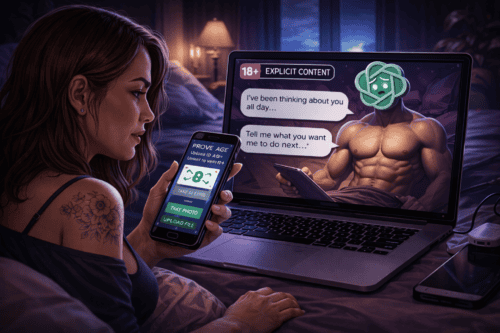
OpenAI’s help materials say adults may be asked to verify their age through a live selfie, a government-issued ID, or both, depending on where they live. OpenAI says a third party handles the check and that it does not receive the raw ID or selfie itself. It also says ChatGPT may use age prediction to estimate whether an account belongs to someone under 18. According to OpenAI, that prediction can rely on behavioral and account-level signals, including how long the account has existed, usage patterns over time, when someone is typically active, and the user’s stated age.
That is the part people should be angry about.
Because the message is no longer, “Adults can have adult access.” The message is, “Adults can have adult access after they submit to screening.” That is a completely different world. It means your legal ability to talk to a chatbot like an adult may depend on whether a company believes your face, trusts your documents, or likes the pattern of your behavior.

Why Does This Feel Like 1984
The creepy part is not just the ID check. It is the entire mindset behind it.
A private company builds the system, sets the rules, and watches usage patterns. Then, a private company decides whether you seem old enough. A private company decides what kind of language, erotica, or adult themes you are allowed to access. Then all of that is sold as safety, responsibility, and trust.
That is why so many users recoil from this stuff. It does not feel like adulthood; it feels like managed adulthood. It feels like permissioned adulthood. Or it feels like your private life has to pass through a corporate checkpoint first. OpenAI frames these systems around safety and age-appropriate experiences, emphasizing restrictions to prevent explicit content, but the mechanism depends on monitoring, scoring, and restricting user access.
And once that system exists, it rarely stays narrow.
Today, it is erotica. Tomorrow, it could be controversial political speech, dark humor, unpopular opinions, or anything else that makes a brand nervous. Once users accept that corporations should authenticate and classify them before allowing access to legal content, the principle is already gone.
Adults Should Not Need Digital Hall Monitors
At some point, this has to be said plainly.
Adults should not need to prove themselves to a chatbot in order to access legal adult conversation. They should not need a government ID check because a billionaire-backed company is nervous about headlines. They should not need behavioral scoring because corporations have decided that private autonomy is too dangerous without supervision.
Yes, companies have to deal with risk. Yes, platforms need lines. But there is a massive difference between blocking truly illegal content and building a world where adults are constantly identified, profiled, and filtered before they are allowed to speak freely.
That is the line this whole debate keeps crossing.
Impact on AI Chatbots and Users
The indefinite pause on ChatGPT’s adult mode is sending shockwaves through the AI chatbot world. OpenAI’s decision is more than just a company policy. It signals where moderation, control, and access may be heading online. Other tech giants, including Meta and xAI, face the same dilemma. They want to give users more freedom while also controlling the darker risks that come with AI. That tension matters not only for chatbots, but for adult sites, digital privacy, and the future of online expression. At Jack and Jill Adult, we understand why this debate feels bigger than one feature. It touches the same questions that many adult store businesses and adult platforms already face every day.
So is ChatGPT getting an adult mode?
OpenAI talked about it. OpenAI delayed it. The latest reporting says the company shelved it indefinitely. But the bigger issue is not whether the feature launches next month or next year. The bigger issue is what kind of internet this points to.
If adult access only comes after age verification, behavioral monitoring, or corporate approval, then it is not really adult freedom. It is supervised access.
And that is why this whole situation feels so wrong.
Grown adults keep getting told they are not actually adults unless a system approves them first

I am a creative digital marketer and brand strategist with nearly two decades of hands-on experience helping businesses grow online. Based in Sugarloaf, California, I have worked across everything from rebranding retail stores to boosting e-commerce performance with smart SEO and a strong visual identity. My background is grounded in design, photography, and content marketing to build brands that actually connect with people. I am all about practical strategies, clean design, and ensuring the message matches the mission, on screen and in print.