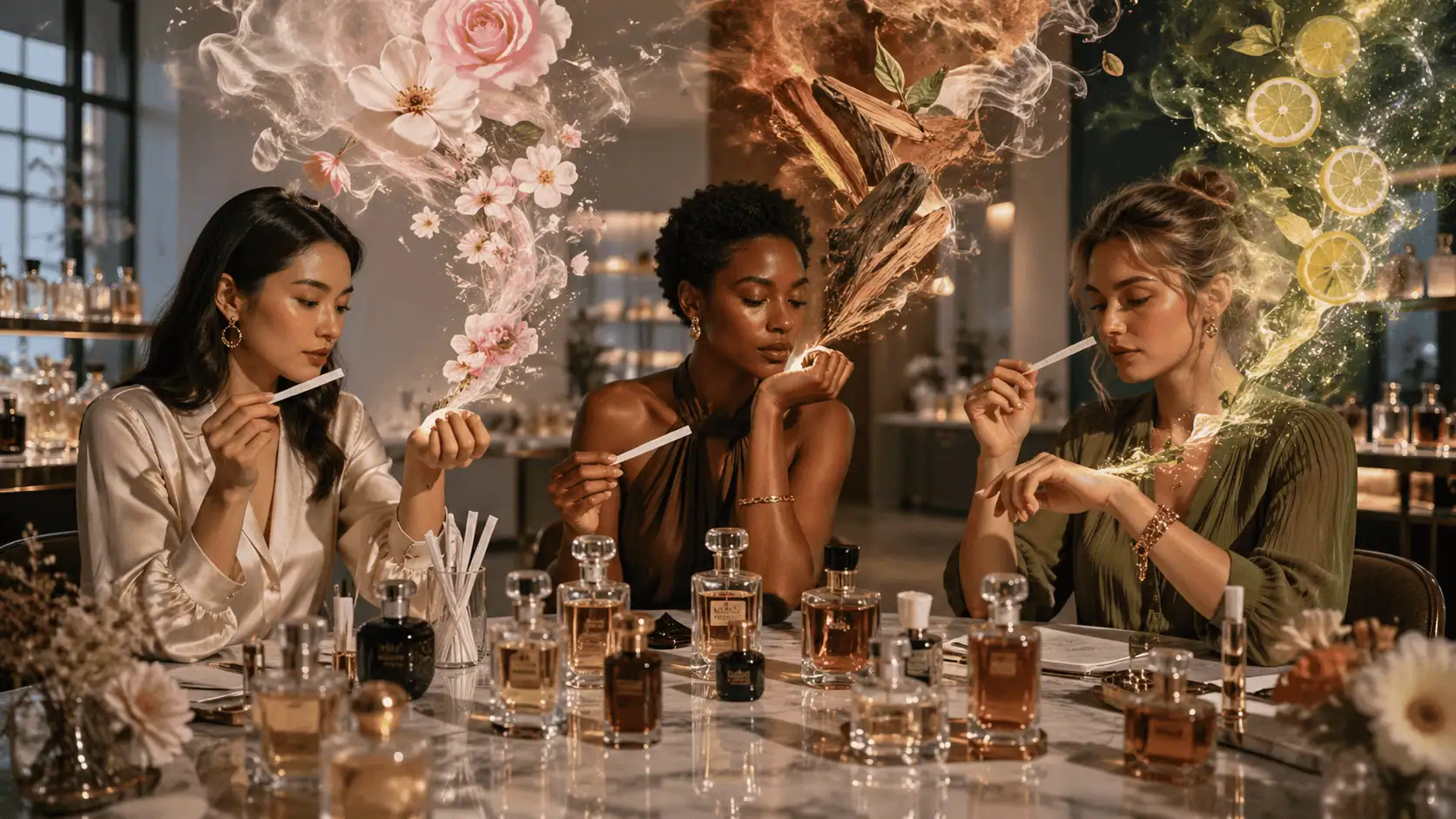
How Skin Chemistry Changes Perfume
You can spray the same perfume from the same bottle on two people and get two different results. One person may smell soft, warm, and smooth. Another may smell sharp, powdery, or much sweeter. That is not your imagination. Skin chemistry changes perfume in real ways, which is why the same fragrance can smell different from person to person.
A lot of people blame the perfume first. Sometimes the issue is not the fragrance at all. It is body chemistry, skin type, hydration, body temperature, and natural scent changing the way fragrance molecules interact with the skin. That is why a perfume smells amazing on your friend, then lands completely differently on you.
If you have ever wondered why perfume smells different on your skin, or why your favorite perfumes do not always smell the same throughout the day, skin chemistry is usually a big part of the answer.
What Skin Chemistry Means In Perfume
Skin chemistry is the mix of factors on your skin that affects how a fragrance develops. That includes your skin’s pH level, natural oils, hydration levels, body odor, body temperature, hormone shifts, and even the bacteria that live on the skin.
All of that matters because fragrance molecules do not just sit there unchanged. They react to warmth, oil, moisture, and air. They evaporate at different speeds. They blend with your natural scent. That is why perfume smells slightly different on every person, even when the formula is identical.
This is also why people chase a signature scent for years. The right perfume is not only about the bottle. It is about how that fragrance interacts with your unique skin chemistry and personal chemistry.
Why The Same Perfume Smells Different On Different People
The short answer is simple. Fragrance molecules interact with each person’s skin in a different way.
The longer answer is more interesting.
Your body chemistry affects how quickly top notes burn off, how middle notes open up, and how base notes settle into the skin. One person may pull more sweetness from a scent. Another may bring out the wood, spice, musk, or citrus. The same fragrance can smell creamy on oily skin, dry on acidic skin, or much brighter on warmer skin.
That is why the same perfume can smell completely different from one person to the next. It is also why paper blotters only tell part of the story. A strip can show you the basic scent profile, but it cannot show you how fragrance develops on your skin throughout the day.
How Skin Type Changes Fragrance Performance
Skin types matter more than most people realize. Oily skin, dry skin, combination skin, sensitive skin, and normal skin all change fragrance performance in different ways.
Oily Skin Usually Holds Perfume Longer
Oily skin often helps fragrance last because natural oils trap scent molecules better. That means fragrance longevity is usually stronger, projection can be better, and the scent may feel richer or deeper for longer.
This is one reason perfume smells stronger on some people. Their natural skin oils are giving the fragrance more to hold onto. Certain notes, especially warm, musky, sweet, or woody notes, may feel fuller and rounder on oily skin.
Dry Skin Can Make Fragrance Fade Faster
Dry skin usually gives perfume less to grip. Without enough natural oils, fragrance molecules evaporate more quickly. That often means top notes vanish faster, the whole scent feels lighter, and reapplication becomes more tempting.
This is why people with dry skin sometimes think a perfume is weak when the real issue is that the skin is not helping it last. A well hydrated skin surface gives better fragrance performance than dry, thirsty skin.
Combination And Sensitive Skin Can Be Less Predictable
Combination skin can behave differently depending on where you apply perfume. Sensitive skin adds another issue because irritation can make someone spray less or avoid stronger formulas. In both cases, testing on skin matters more than guessing based on bottle type alone.
The Role Of Natural Oils And Natural Scent
Perfume does not exist in a vacuum. It lands on top of your natural scent, your body odor, and your skin’s own oil balance.
That is not a bad thing. In fact, it is often the whole point.
The most interesting fragrances usually smell personal because they blend with the wearer. A perfume becomes a unique scent when fragrance molecules interact with natural skin oils and body chemistry. That is what makes a signature fragrance feel real instead of generic.
Sometimes that works in your favor. Sometimes it does not.
If your natural scent runs warm, musky, salty, or sweet, certain fragrance notes may lean further in that direction. A clean floral may smell more skin-like. A woody scent may smell deeper. A citrus perfume may turn sharper. This is why different scents pull differently on different people.
How Skin PH Affects Perfume
Skin pH is one of those things people love to talk about because it sounds scientific, and in this case, it actually matters. The skin’s pH level usually falls in a mildly acidic range. Small differences in that pH level can change how certain fragrance notes come across.
More acidic skin may make some bright top notes fade faster or smell slightly sharper. Less acidic skin may let certain sweet, musky, or deep notes feel fuller. This does not mean one skin type is better. It just means that chemistry can affect scent in ways that are noticeable.
Still, skin pH is only one piece. People sometimes overfocus on it. In real life, skin chemistry is a full mix of natural oils, hydration, heat, body odor, hormones, and scent molecules interacting at once.
Why Body Temperature Matters
Warmer skin changes perfume. Cooler skin changes it too.
When your skin is warm, fragrance molecules evaporate faster. That can make a scent project more at first, but it can also shorten the fragrance’s longevity. Warmer skin often pushes top notes out faster, which can make a perfume smell brighter or louder early on.
Cooler skin slows things down. That can help fragrance last longer, but it may also make a scent feel more muted at the start.
This is why pulse points matter. Places like the wrists, neck, inner elbows, and areas near visible blood vessels give off more heat. When you apply perfume there, the warmth helps the fragrance open up and move through the day. It can also help you get a more accurate impression of how the perfume reacts once it is actually on your body.
Hormones Can Change The Way Perfume Smells
Hormonal fluctuations can absolutely change fragrance.
The menstrual cycle can shift skin pH, body odor, oil production, and sensitivity to smell. That means the same perfume may smell different from one week to the next. A fragrance that feels soft and balanced one day may smell stronger, sweeter, or more annoying another day.
Pregnancy can create even bigger changes. Some scents that once smelled great can suddenly smell completely off or overwhelming. Stress hormones can do their own damage too. Higher stress can influence sweat, body odor, and skin behavior, all of which affect how fragrance develops.
This is one reason people should not panic if a new fragrance smells wrong on a single day. Sometimes the perfume is not the problem. Sometimes your body chemistry is just in a different place.
Diet And Lifestyle Can Change How Perfume Wears
What you eat and drink can affect how you smell, which affects how perfume smells on you.
Spicy foods, garlic, onion, alcohol, and caffeine can all influence sweat and body odor. High-intensity workouts can do the same. If your body is producing more sweat or a stronger natural odor, fragrance interacts with that. Sometimes the result is still great. Sometimes the scent turns heavier, sharper, or just different.
Hydration matters too. Well hydrated skin usually gives fragrance molecules a better surface than dehydrated skin. If you are dried out from heat, alcohol, or poor water intake, the fragrance may not perform as well.
This is another reason a perfume can smell different throughout the day or from season to season. Your body is not static. Your personal chemistry shifts.
Why Top Notes, Middle Notes, And Base Notes Matter On Skin
Perfumes develop in stages. That development is shaped by skin chemistry.
Top notes are what you smell first. They are often light, fresh, and quick to evaporate. Citrus, bergamot, lemon, and airy herbal notes often live here.
Middle notes come next. These are the heart of the fragrance. Floral, spicy, fruity, and aromatic notes often show up here.
Base notes are the foundation. Musk, amber, woods, vanilla, and deeper resins tend to sit here. These notes usually last the longest and often say the most about how a fragrance really wears on a person.
When perfume reacts with your skin, the timing of these stages changes. On warmer skin, top notes may disappear faster. On dry skin, the whole arc may feel shorter. On oily skin, the base note may linger much longer. That is why the same fragrance can smell slightly different at every stage depending on who is wearing it.
Why Testing Perfume On Skin Matters More Than Paper
A paper strip is a preview. Your skin is the real test.
If you want to know how a perfume smells on you, you need to wear it. Spray it on your wrist or inner elbows and give it time. Do not decide in the first minute. The opening can be misleading. Some fragrances smell rough at first, then settle beautifully. Others smell amazing immediately, then fall flat.
A better test is to wear the fragrance for at least a full day. For some people, testing for 24 to 48 hours across a few wears gives a much clearer picture. That lets you see how the scent changes with body temperature, hydration, natural oils, and movement throughout the day.
That is the only way to know if the right perfume is actually right for your skin.
How To Make Fragrance Last Longer On Dry Skin
If you have dry skin, there are a few easy fixes that can improve fragrance longevity.
Start with unscented moisturizers or a light body oil. A hydrated base helps fragrance molecules anchor better. You can also use matching body lotion or scented lotions if they pair well with the fragrance, but unscented moisturizers are safer when you do not want to distort the perfume.
Apply perfume after moisturizing, not before. Then focus on pulse points like the wrists, neck, and inner elbows. Do not rub the fragrance in too aggressively. Let it sit and develop.
If your skin is dry most of the time, you may also do better with stronger concentrations than a light eau de toilette. Richer formulas often hold up better when the skin is not naturally oily.
Why The Same Bottle May Smell Different By Season
Seasons change your skin. That changes your perfume.
In hotter weather, warmer skin and more sweat can make fragrance feel stronger, brighter, and sometimes shorter-lived. In colder weather, cooler skin can slow development and make certain notes feel more closed down.
Humidity changes things too. So does sun exposure. So does indoor heat.
That is why some people end up building a fragrance wardrobe instead of relying on one signature fragrance year-round. Fresh citrus, airy floral, and light eau de toilette styles may feel right in summer, while woody scents, amber, musk, and deeper spicy notes may perform better in cooler months.
The same formula does not always behave the same way in every season.
Common Mistakes People Make When Testing Perfume
One of the biggest mistakes is testing too fast. If you spray and judge within a minute, you are only smelling the top notes. That is not enough.
Another mistake is testing too many different perfumes at once. Your nose gets tired. Everything starts blending together, and you lose any accurate impression of how different fragrances actually smell.
A third mistake is ignoring your own skin type. People with dry skin often assume the perfume is weak. People with oily skin may think the fragrance is too strong when really their skin is projecting it more.
Another common one is testing perfume on paper only, then buying the bottle. That skips the whole issue of body chemistry affects fragrance.
And finally, people often forget what they layered underneath. Scented lotions, body oils, soaps, and even detergent can shift how a fragrance smells. If you want to test clearly, keep the rest of the routine simple.
How To Find The Right Perfume For Your Chemistry
The right perfume is not always the one that smells best in the bottle. It is the one that smells best on your skin after real wear.
Start by noticing patterns. Maybe woody scents work better on you than sugary scents. Maybe citrus disappears too fast. Maybe musk, amber, or floral notes give you a more balanced result. The more you test, the easier it gets to spot which fragrance families fit your unique body chemistry.
Pay attention to how fragrance smells after 15 minutes, after two hours, and at the end of the day. Notice whether it turns sharp, sweet, flat, powdery, or richer. That is where the real information is.
A good signature scent feels believable on your skin. It does not smell pasted on. It feels like an extension of your personal style, your warmth, and your natural scent.

The Truth About Skin Chemistry And Perfume
Skin chemistry changes perfume in ways that are easy to notice once you know what to look for. Body chemistry affects how fragrance develops, how long fragrance lasts, how top notes open, and how the deeper fragrance notes settle into your skin. That is why the same perfume can smell different on different people, even when it comes from the same bottle.
Dry skin, oily skin, natural oils, body temperature, skin pH, hormones, diet, sweat, and hydration levels all shape the result. That is not a flaw. It is part of what makes fragrance personal.
So if a new fragrance smells off, do not assume the perfume is bad. Test it on your skin. Give it time. Try it in different weather. Wear it with well-hydrated skin. Pay attention to how the fragrance interacts with your body instead of how it smells on paper.
That is how you stop chasing random hype and start finding perfumes that actually smell great on you, which is exactly why Jack and Jill Adult keeps exploring scent, attraction, and personal chemistry in a more honest way.

I am a creative digital marketer and brand strategist with nearly two decades of hands-on experience helping businesses grow online. Based in Sugarloaf, California, I have worked across everything from rebranding retail stores to boosting e-commerce performance with smart SEO and a strong visual identity. My background is grounded in design, photography, and content marketing to build brands that actually connect with people. I am all about practical strategies, clean design, and ensuring the message matches the mission, on screen and in print.